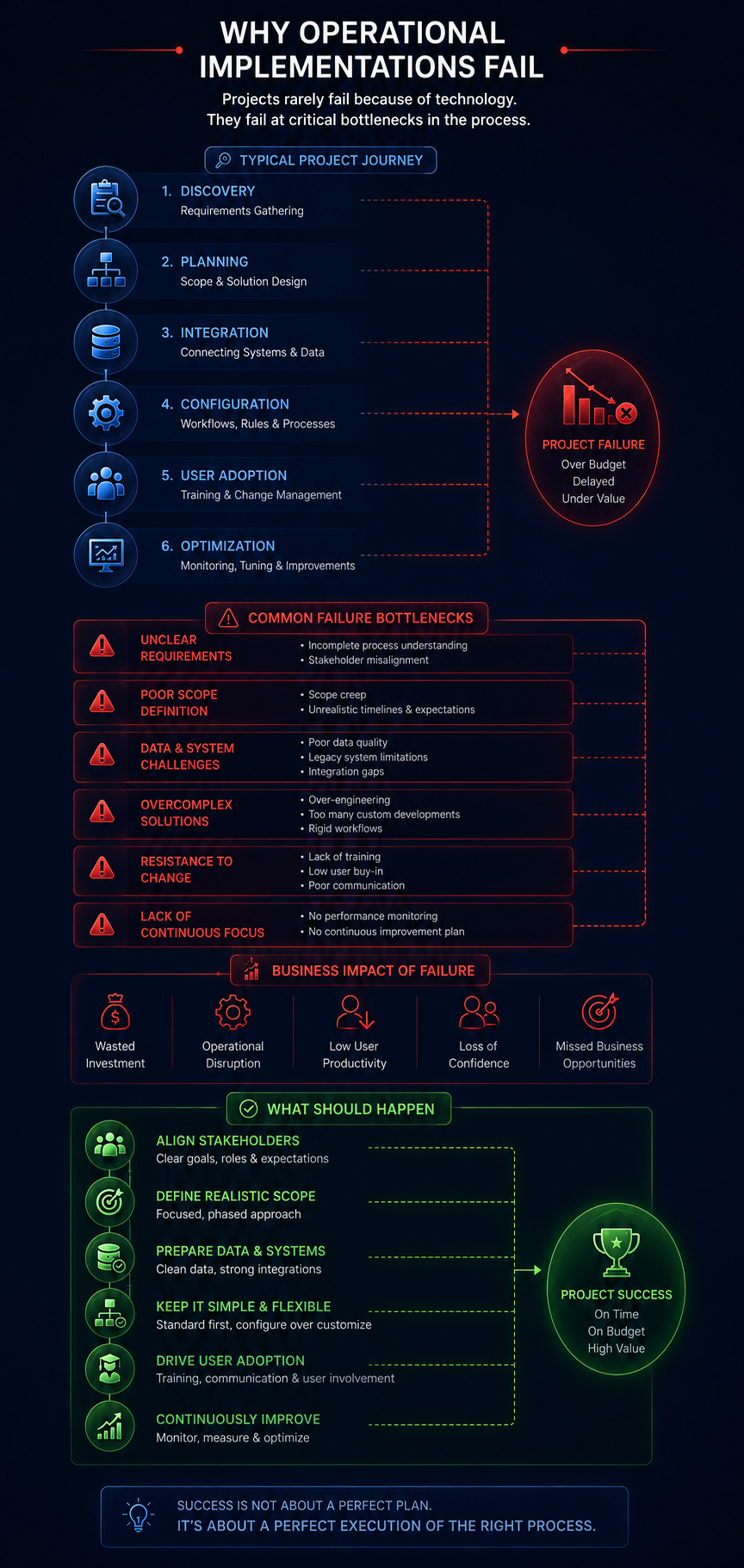
Why Most Operational Software Projects Fail Before They're Built
Most operational software projects fail for the same reason: a platform gets selected and configured against documented procedures before anyone fully understands the operation it's meant to serve. The configuration breaks the moment it meets how the floor actually works - which is rarely identical to what the SOP describes. This is the gap between buying software and having software engineered around your operation.
The most common points of failure are unclear objectives at the outset, a shallow understanding of actual floor or field behaviour versus documented process, and a default instinct to replace existing systems rather than build the integration layer around them. We see this pattern repeat across manufacturing plants, logistics depots, warehouses, and industrial sites alike - and it's exactly why we engineer rather than configure.
A disconnected stakeholder group makes this worse - IT selecting software without input from operations managers, supervisors, or the people running the floor virtually guarantees low adoption and a system producing dashboards nobody trusts enough to act on.
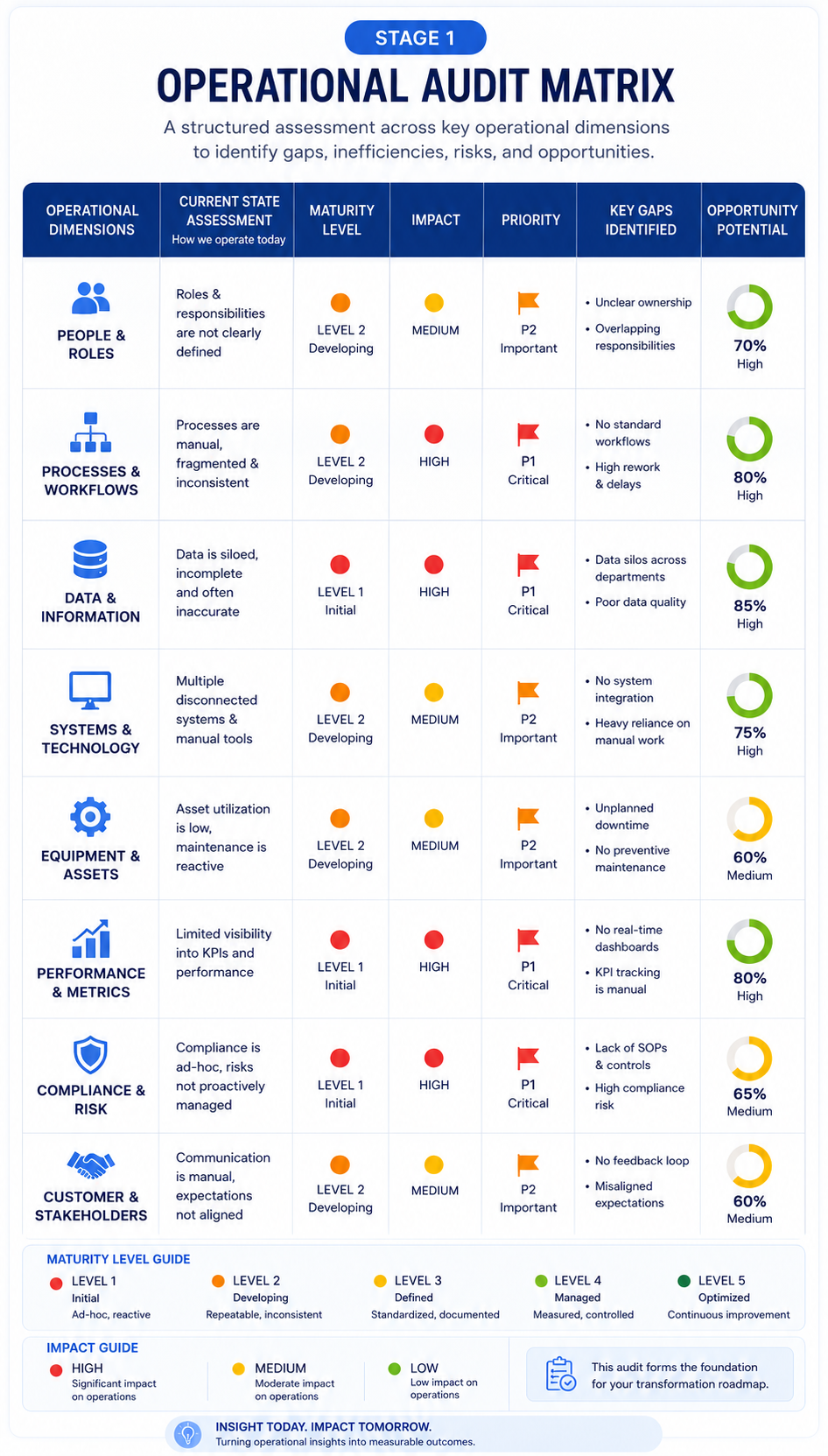
Operational Assessment
Goal
Understand the reporting bottlenecks, workflow delays, visibility gaps, and operational pain points across the floor, the field, and the systems already in place - before any design or build work starts.
Activities
- Stakeholder interviews with operations managers, supervisors, and floor or field teams
- Workflow and process review - how work actually happens, not just how the SOP describes it
- Existing system inventory - ERP, WMS, SCADA, CMMS, spreadsheets, and manual logs currently in use
- Current reporting cycle and data lag analysis
Deliverables
- Complete operational findings document
- Visibility gap assessment report
- High-level workflow overview map
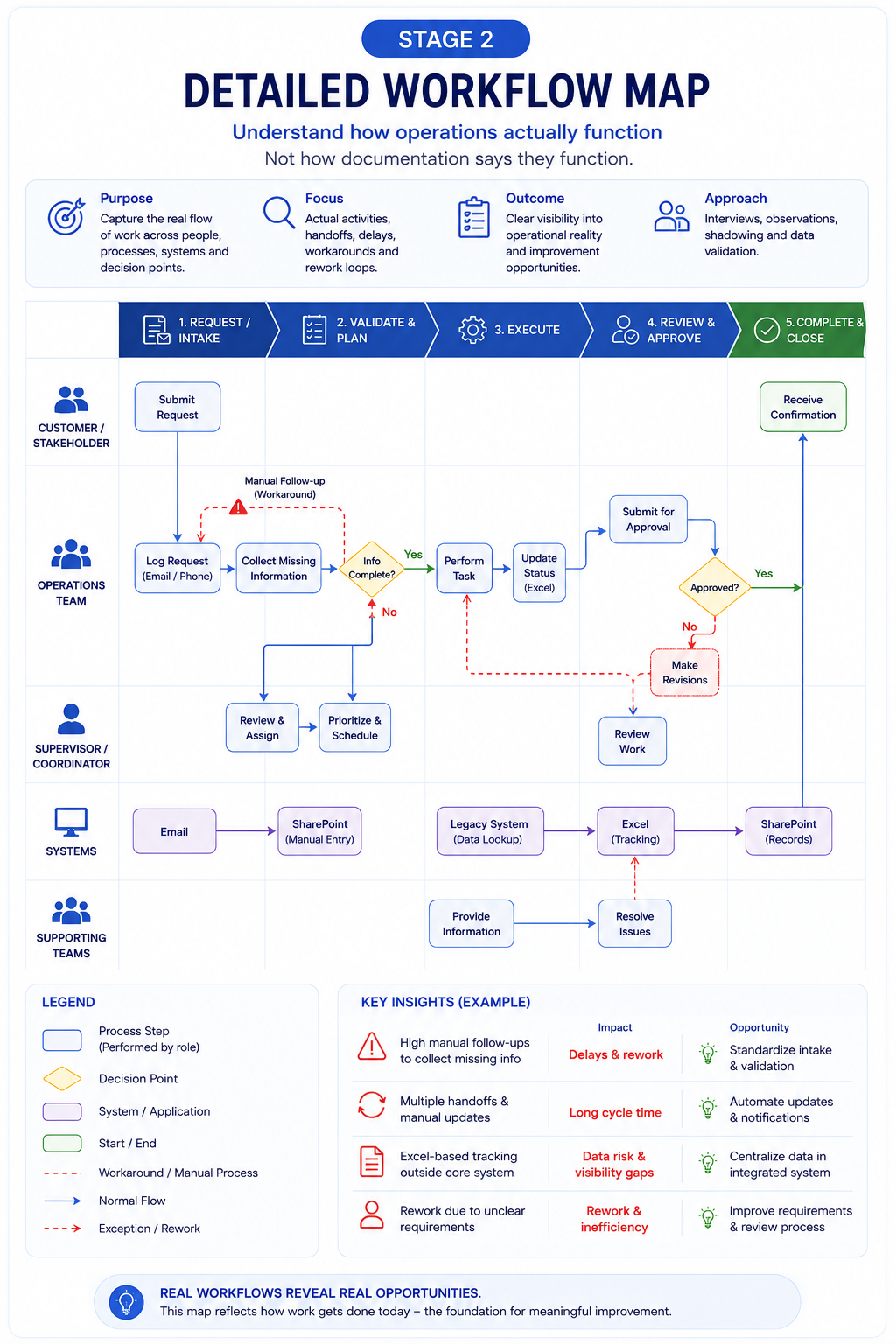
Workflow Mapping
Goal
Understand how operations actually function in practice - including the informal coordination, verbal handovers, and workaround steps that documentation never captures, and that a generic software configuration would miss entirely.
Activities
- Mapping manual and digital approval chains end to end
- Tracking daily and shift-based reporting loops as they currently run
- Following dispatch, yard, and field coordination flows
- Reviewing warehouse, manufacturing, or industrial-specific workflows relevant to your operation
Deliverables
- Detailed, realistic workflow diagrams
- Identified bottlenecks ranked by operational and cost impact
- Prioritised automation opportunity list
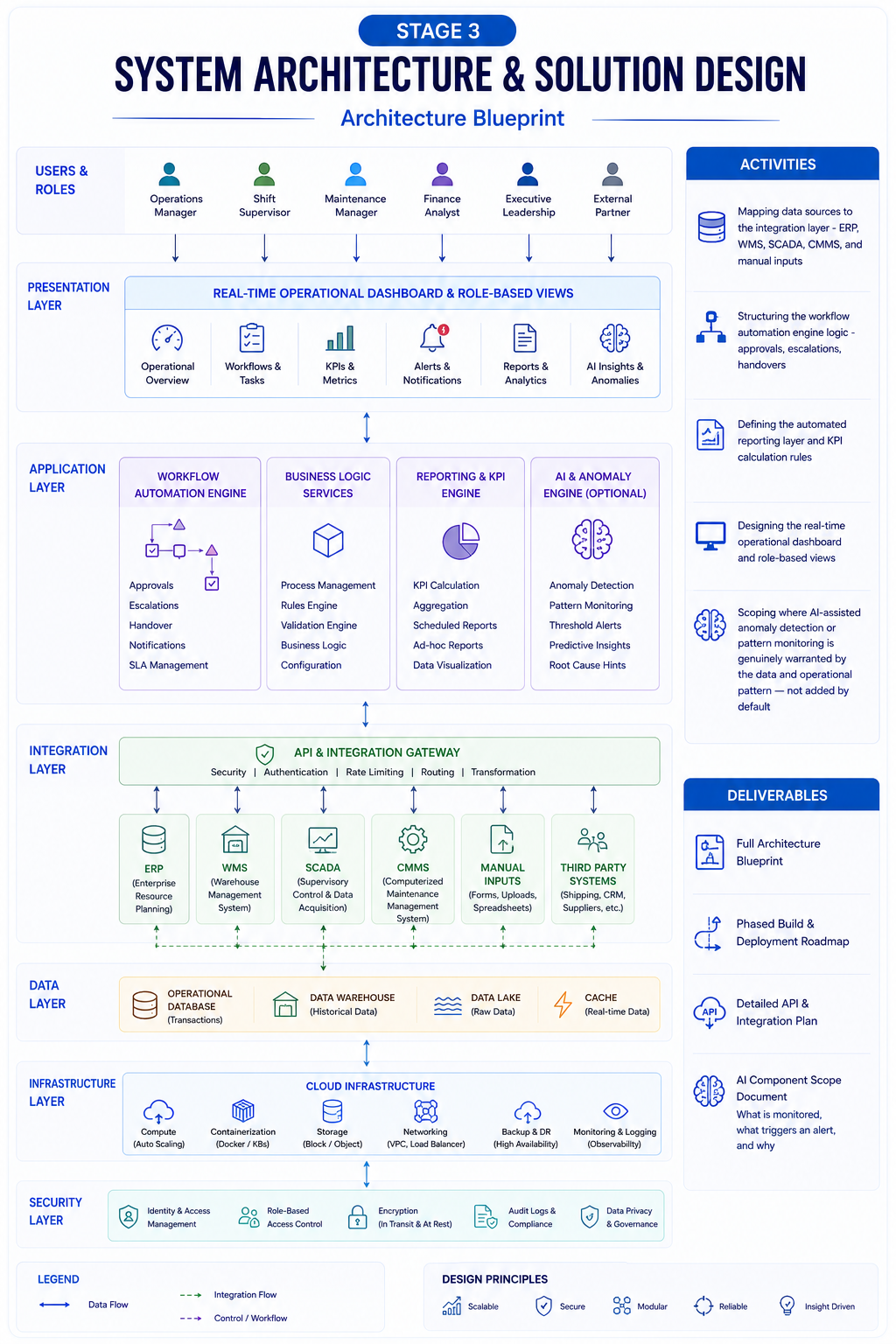
System Architecture & Solution Design
Goal
Engineer the blueprint for a non-disruptive visibility and automation layer that sits above your existing technology - including where AI-assisted monitoring genuinely adds value, and where a simpler rule-based system is the better build.
Activities
- Mapping data sources to the integration layer - ERP, WMS, SCADA, CMMS, and manual inputs
- Structuring the workflow automation engine logic - approvals, escalations, handovers
- Defining the automated reporting layer and KPI calculation rules
- Designing the real-time operational dashboard and role-based views
- Scoping where AI-assisted anomaly detection or pattern monitoring is genuinely warranted by the data and operational pattern - not added by default
Deliverables
- Full architecture design blueprint
- Phased build and deployment roadmap
- Detailed API and integration plan
- AI component scope document - what is monitored, what triggers an alert, and why
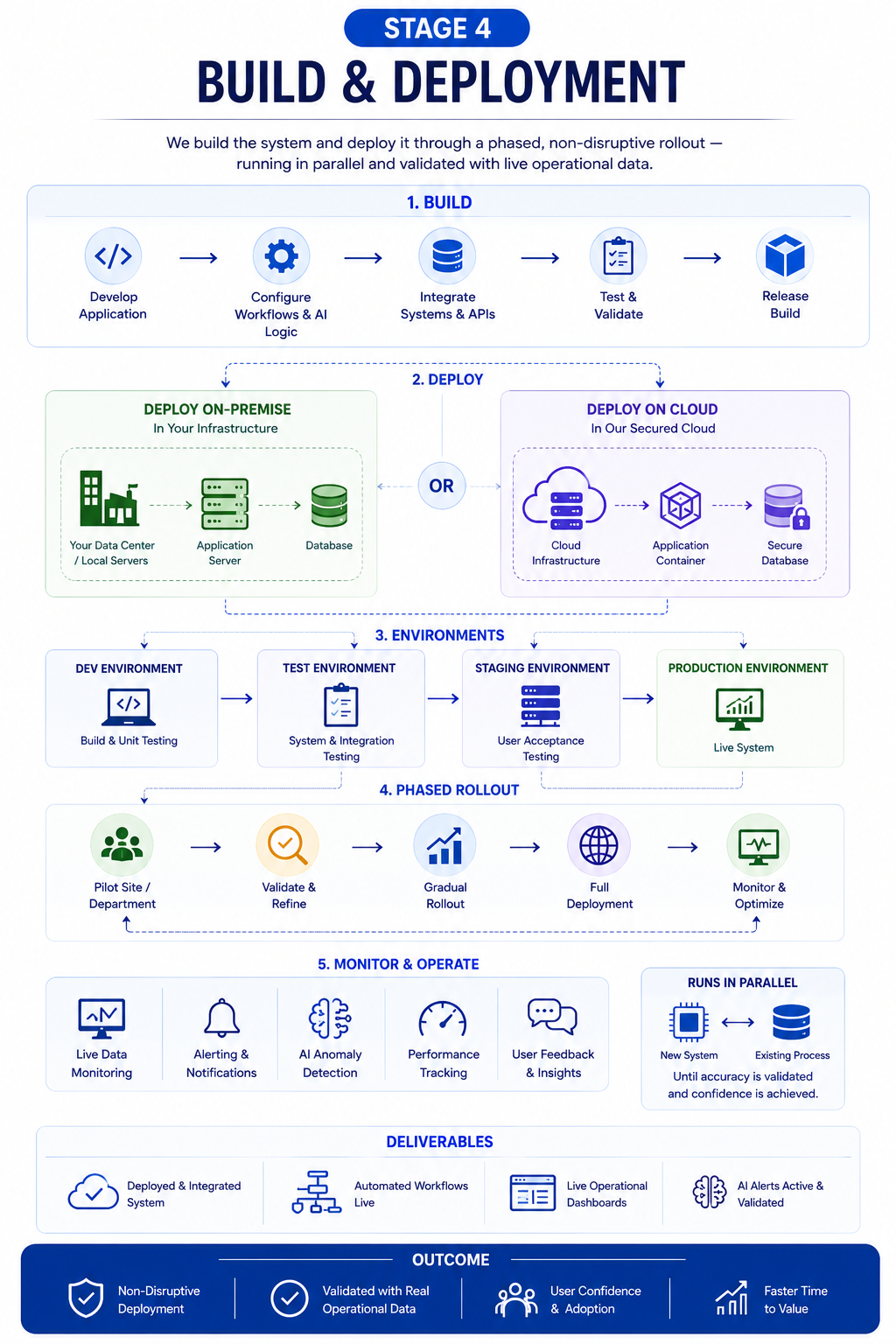
Build & Deployment
Goal
We build the system to the architecture, then deploy it through a phased, non-disruptive rollout - validated against live operational data in parallel with your existing process, without a forced cutover.
Activities
- Engineering the ERP, WMS, SCADA, and CMMS integration connectors via API, database connection, or scheduled data exchange
- Building and configuring workflow automation rules and approval routing logic
- Building the operational dashboard and connecting it to live data
- Configuring reporting triggers, alert thresholds, and AI alert logic
- Running the deployed system in parallel with existing manual processes until accuracy is fully validated
Deliverables
- Fully built and integrated visibility and automation layer
- Tested and deployed workflow automation logic
- Live operational dashboards running on your data
- Validated AI alert thresholds calibrated against your real operational data
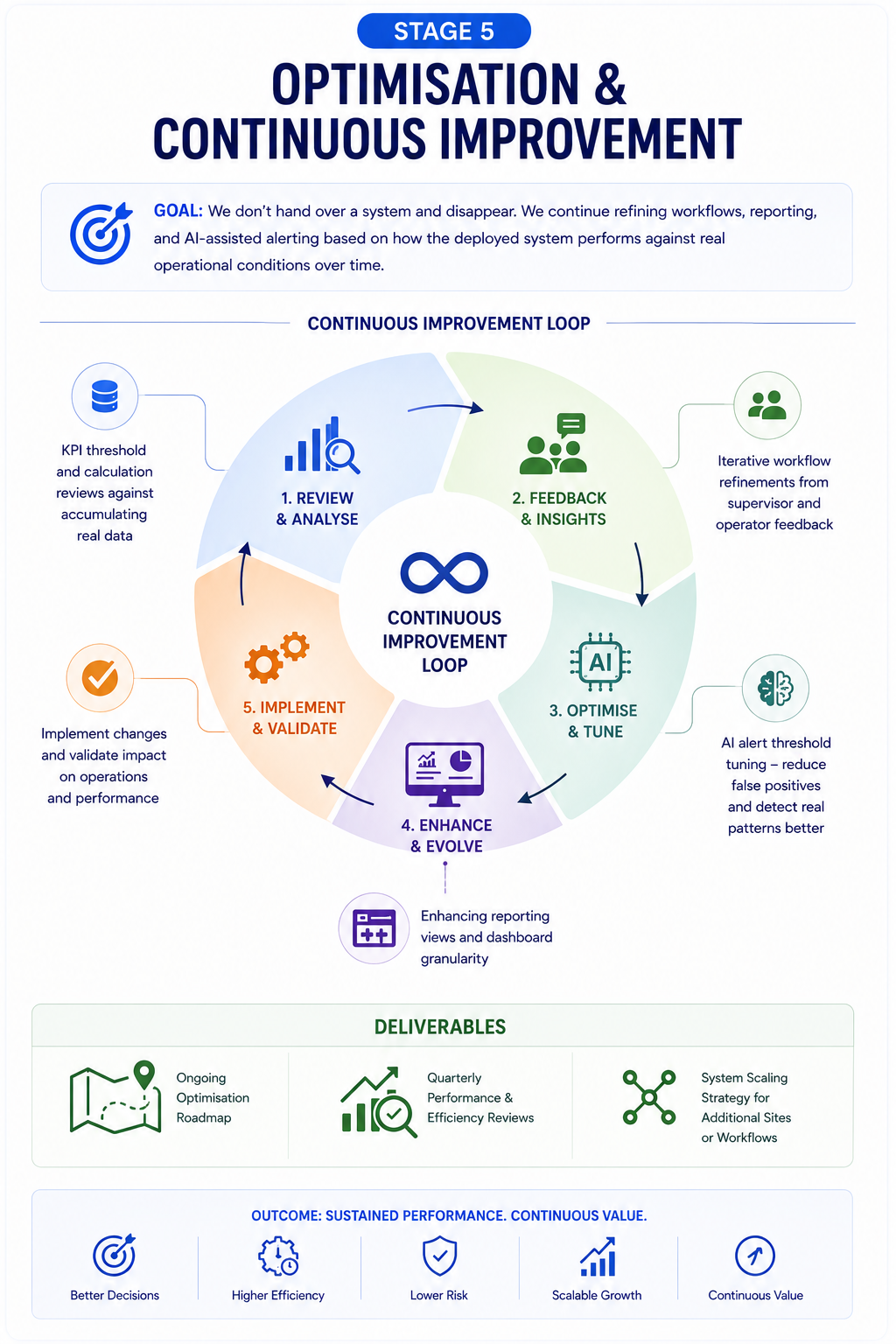
Optimisation & Continuous Improvement
Goal
We don't hand over a system and disappear. We continue refining workflows, reporting, and AI-assisted alerting based on how the deployed system performs against real operational conditions over time.
Activities
- KPI threshold and calculation reviews against accumulating real data
- Iterative workflow refinements from supervisor and operator feedback
- AI alert threshold tuning - reducing false positives and sharpening genuine pattern detection as historical data accumulates
- Enhancing reporting views and dashboard granularity
- Identifying new operational insights surfaced by the system once it has live history to draw on
Deliverables
- Ongoing optimisation roadmap
- Quarterly performance and efficiency reviews
- System scaling strategy for additional sites or workflows
How We Build and Deploy Without Being On-Site
Every stage above is engineered for structured remote delivery - video sessions with your operations, IT, and floor teams, screen-shared system walkthroughs, and document-based architecture review. This is not a workaround; it's how we design, build, and deploy for clients across Perth, Adelaide, Dammam, and Al Khobar today. It works because the assessment draws on your team's direct knowledge of the operation, and the build itself is engineering work we do independently of physical location.
For field and inspection systems specifically - mobile applications used in remote mining corridors, warehouse floors, or low-connectivity industrial sites - testing and validation are coordinated through your on-site coordinators and supervisors, who run the deployed system against real conditions while we monitor performance and refine it remotely.
Technology We Build With
We choose tools based on the operational environment - not trends. The stack below represents the technologies we regularly deploy across industrial, logistics, and warehouse systems.
Dashboards & Interfaces
Backend & Automation Engines
Databases
Mobile Field Applications
Integration Protocols
Cloud Deployment
ERP Connectors
CMMS Connectors
SCADA & Historian
What We Don't Do
We don't replace systems unnecessarily. If your ERP, WMS, or SCADA works, we build the integration layer around it rather than rebuilding it.
We don't force a 'rip-and-replace' migration that halts your operations to install something new.
We don't implement automation or AI monitoring without first understanding the actual physical and operational workflow it needs to fit.
We don't add AI features because they sound impressive on a page. We build them where pattern detection or anomaly alerting genuinely improves on what manual review can catch - and we build the simpler, rule-based alternative when that's the better engineering decision.
We don't optimise dashboards and reports before fixing the underlying workflow and data delays that made them unreliable in the first place.
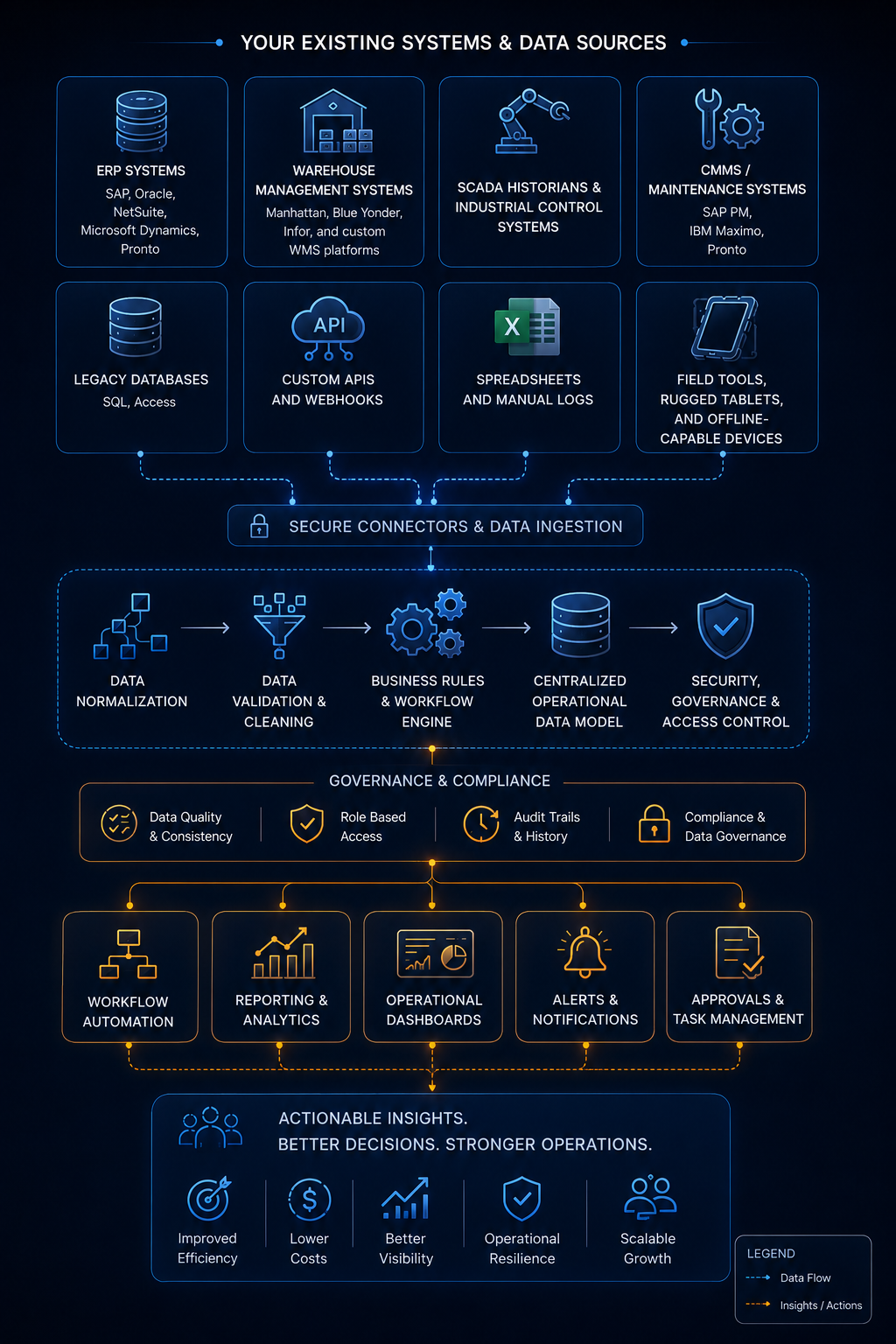
Systems We Build Integrations For
Frequently Asked Questions
Everything you need to know about implementing Operational Intelligence.
No. We engineer the integration and visibility layer to sit above your existing ERP, WMS, or SCADA - not to replace it. We extract data via API, database connection, or scheduled data exchange without modifying your existing transactional systems or requiring any system replacement.
A focused pilot covering one or two core workflows - such as automated dispatch reporting or a single approval workflow - is typically built and deployed within 4 to 8 weeks. A complete operational intelligence system covering multiple workflows, full ERP and WMS integration, and multi-site visibility typically runs 8 to 16 weeks depending on scope and the number of systems involved. We scope this precisely during the assessment stage rather than quoting a generic timeline.
Yes - and we generally recommend it. Building and deploying a pilot at a single facility or with one or two core workflows lets you validate the workflow maps and see real operational value before committing to a full multi-site or multi-workflow build. Most of our larger engagements started this way.
That's exactly what Stage 2 - Workflow Mapping - is built for. We don't rely on outdated SOPs or assume documentation reflects reality. We interview operators and supervisors and map how work actually happens on the floor or in the field, which is very often different from what's written down - and we build the system around that reality, not the documentation.
We build AI-assisted components - anomaly detection, pattern monitoring, natural language report summaries - specifically where the operational data and pattern genuinely warrant it, which we determine during Stage 3 (Architecture & Solution Design). We don't add AI features by default to every build. If a workflow is better served by a simple rule-based threshold alert than a machine learning model, that's the system we build. The AI Component Scope Document produced at Stage 3 sets out exactly what's monitored, what triggers an alert, and why - before any of it is engineered.
Yes. We build integrations with major WMS platforms (Manhattan, Blue Yonder, Infor, and custom builds), CMMS and maintenance platforms (SAP PM, IBM Maximo, Pronto), and SCADA historians or industrial control systems - pulling inventory thresholds, picker cycle times, equipment telemetry, and maintenance work order data in real time as part of the same integration layer we deploy.
Every stage of our process - from the initial operational assessment through to deployment - is engineered for structured remote delivery. We run video sessions with your operations, IT, and floor or field teams, conduct screen-shared walkthroughs of existing systems, and review documentation collaboratively. For field-based systems specifically, testing happens through your on-site coordinators running the deployed system under real conditions while we monitor and refine it remotely. This is how we build and deploy across every market we work in today.
A generic software development agency builds applications to a brief. We engineer operational intelligence systems specifically for industrial, logistics, manufacturing, and warehouse environments - which means the assessment and workflow mapping stages exist because operational software that doesn't account for how a floor or field crew actually works will be configured correctly and still fail to get adopted. We build the integration layer around your specific ERP, WMS, or SCADA setup, not a generic connector. The deliverable is a working, deployed system connected to your existing operations - not a set of recommendations for someone else to build.